

a 2025 Book Report
Highs and lows of the 24 books I read in 2025

In 2024, I realized I was not reading nearly as much as I’d wanted or needed to. Or more truthfully — in 2024, I was ready to actively change that. So I set the goal to read one book per month and just barely fell short. But it didn’t really matter because the habit was formed. My childhood love of reading was so back. So this year, I upped the ante and challenged myself to read 24 books and to my own genuine surprise, I did it! And I took notes along the way.
I present to you: a review of all the books I read, chronologically and as compact as I could bare to make it. Famously, I am not a tough critic. I can’t help but to appreciate art simply because it took effort and courage to make it, but I tried to give a 5 star rating some gravitas. Honestly, none of the books were poorly written, but it’s all subjective, right? This is about my taste. I’m only rating them now as I write this, mostly months after reading, so take that metric with a grain of salt. My goal is only to convey to you, dear reader, which books I’d recommend, and which I think you can pass on. You can find my top 5 at the end!
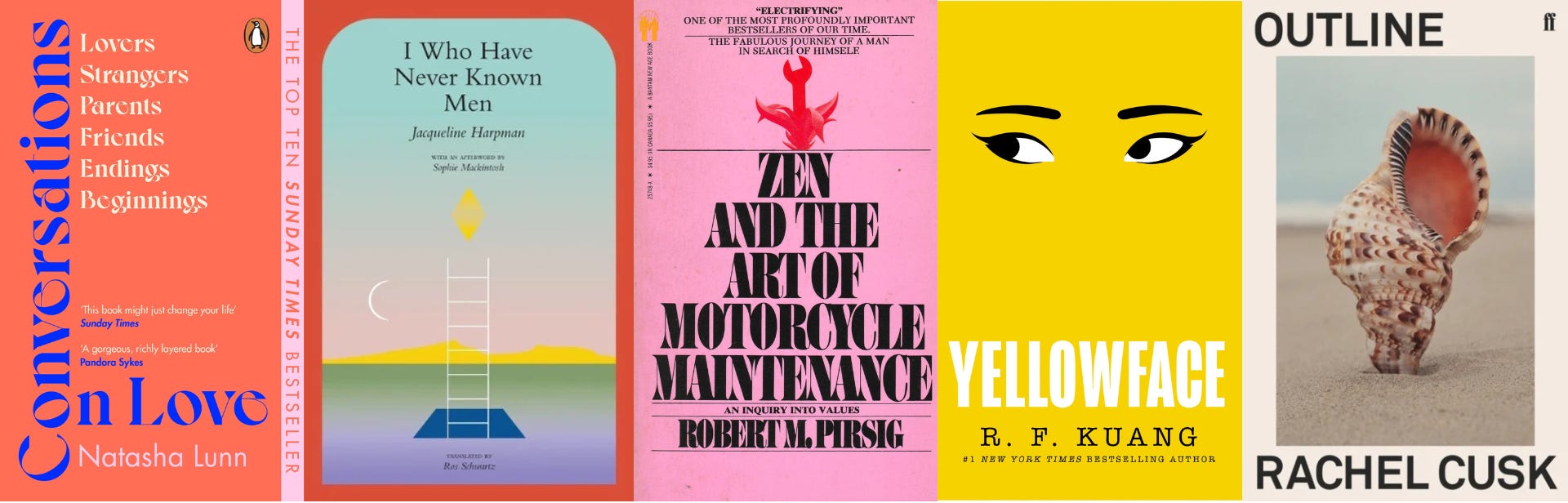
1. Conversations on Love by Natasha Lunn ★★
In what reads more like a long conversation than a self-helpy guide to loving people better, Natasha Lunn interviews heavy hitters like Esther Perel and Roxane Gay to explore topics like treating love as a skill, and the imperfect nature of real intimacy. As intended, it was a refreshing place from which to start my new year, and I took away quite a few underlined nuggets of wisdom. But it wasn’t the most compelling read and after a while I was oddly tired of reading about love. I think I’m just a fiction girly.
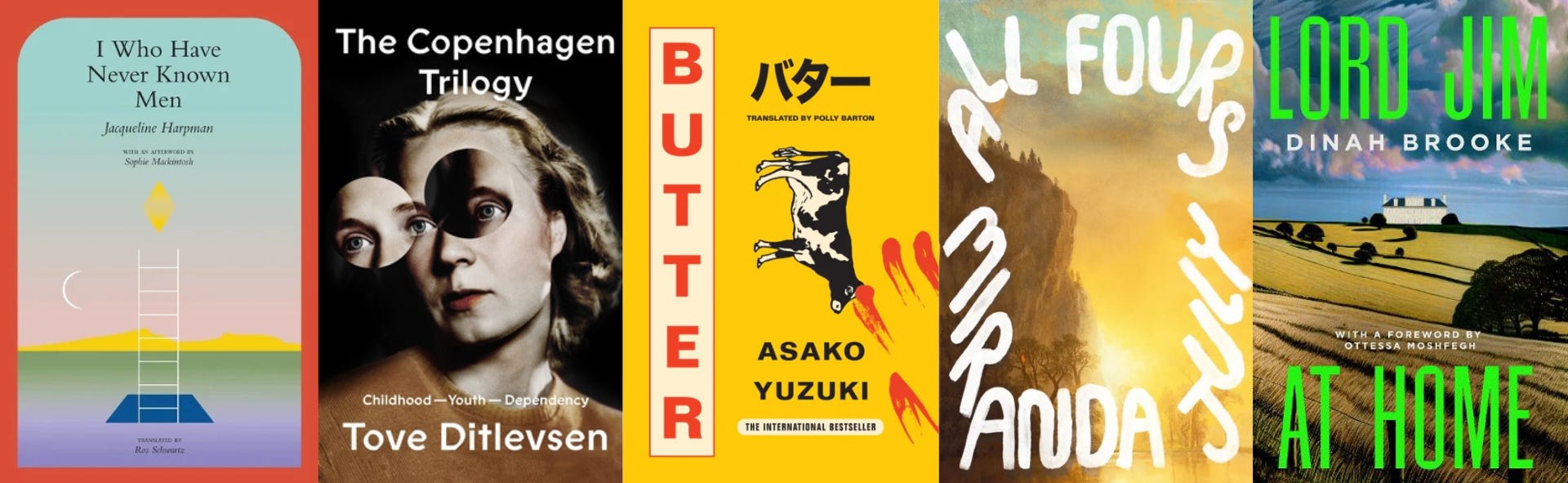
2. I Who Have Never Known Men by Jacqueline Harpman ★★★★★
This book has been everywhere for a reason. If the inexplicable dystopian world Harpman built wasn’t enough, her haunting prose gripped me so intensely, I think it took me all of two afternoons to finish it. There was not a single spare word. It’s an unrelenting mystery. It’s about our need for connection and purpose, and facing uncertainty with courage. It might just sent you into existential reflection about what we require to feel human. This story has stayed with me all year, and I don’t think it will leave me anytime soon. And if that all seems too vague that’s because I don’t want to tell you too much, I just want you to read it!
3. Zen and the Art of Motorcycle Maintenance by Robert M. Pirsig ★★★★
I’ve never read anything quite like this before. Part memoir, part heady philosophical lecture, this is just as much a warning about the consequences of ideological extremism as it is a reflection on the merits of living a slow, intentional life. Pirsig hoists readers onto the back of his motorcycle as he travels across the U.S. with his son and two friends. As we drive through the spectacular scenery, he weaves in his troubling backstory and introduces us to his theoretical white whale: defining the virtue of Quality. I loved this book and what it demanded of me intellectually. It felt like taking a road trip with your whip smart friend who has done a lot of acid. The only reason I’m not giving this 5 stars is because it was long and dense and I was over it about 100 pages from the finish line.
4. Yellowface by R. F. Kuang ★★★
This book reads like juicy gossip you’re hearing straight from the source. It’s about racism, artistic integrity, and the commercialization of identity politics. And I absolutely devoured it. Yellowface is told by deliciously delusional narrator, June Hayward, who tries to dupe the publishing industry as a mediocre and morally questionable author. It’s timely and made me think about the inherent entitlement of Whiteness while hehe haha-ing the whole way through. I think it goes off the rails a bit in the second half but I still really liked this cheeky social commentary.
5. Outline by Rachel Cusk ★
I’m baffled by how popular this book was, or is, or at least seems to be. It genuinely made me wonder if the girlies just liked how the cover looked poking out of their bag on their curated IG feed. Because it was… so… boring? A recent divorcé travels to Athens to teach a creative writing course and uses the stories of those she meets to reveal herself to us slowly. Technically, it’s well written. But I guess the allure of this atypical structure is lost on me; sorry, I’m basic and I need a plot with conflict.
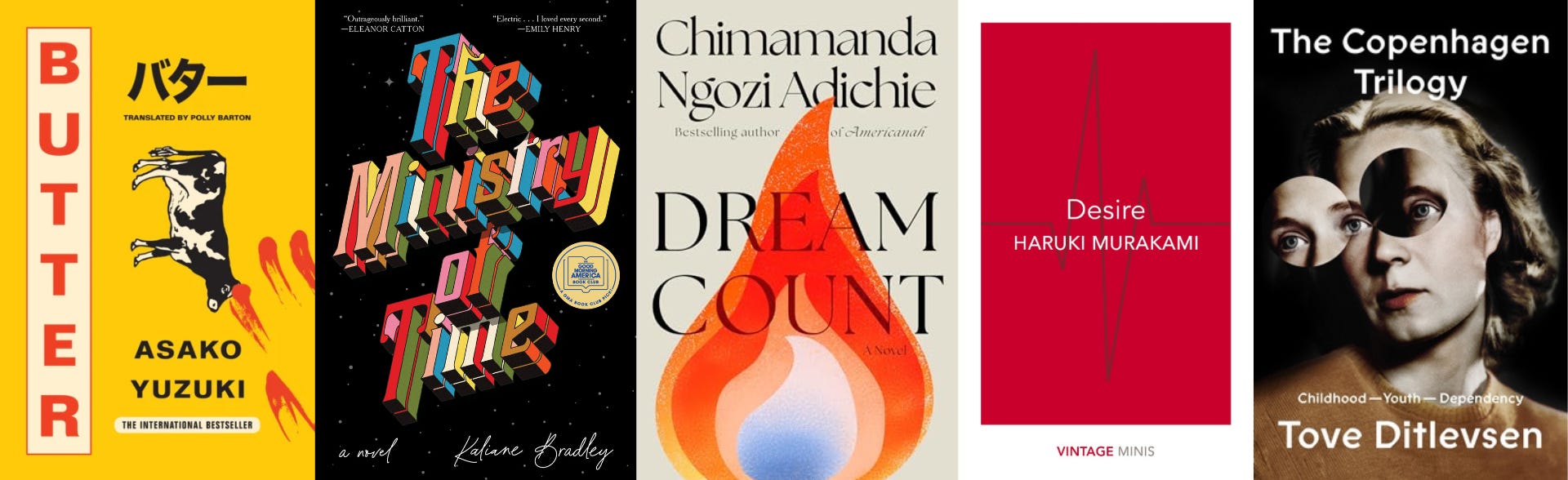
6. Butter by Asako Yuzuki ★★★★★
Now here’s a plot with conflict. And important cultural commentary. And such deliberate descriptions of food, it made me want to be a better cook. Butter is the story of Rika, a journalist in Tokyo who gets a bit too involved with an alleged serial killer as she attempts to earn both her trust and her permission to tell her side of the story. But it’s more than a thrilling true crime story. I mean, isn’t it always? Because behind crimes are the societal pressures that push people to their limits. Butter forced me to reflect on all of that and our global obsession with controlling and subduing women — professionally, domestically, socially, romantically, and through rampant fatphobia. But it also gave me a newfound respect for delicious food and the joy, comfort, and self-love that comes from enjoying it without a sprinkle of shame.
7. The Ministry of Time by Kaliane Bradley ★★★★
A total thrill. Offering me a truly original story is the best thing a book can do for me, and The Ministry of Time set that standard for me this year. Set in near-future London, it follows an unnamed narrator in her top-secret new role as a handler for a super hot time-traveler that she immediately falls in love with. Obviously. The bureaucratic drama that ensues weaves together thought provoking themes of climate anxiety and the politics of foreign aid with more emotional reflections on belonging and how powerless we are in the face of our own desire. In true British fashion, they go a bit bonkers there at the end, but it was entertaining to say the least.
8. Dream Count by Chimamanda Ngozi Adichie ★★★★
I couldn’t bring myself to give Ms. Adichie 3 stars because at the end of the day, her writing is too skillful, her voice is too clear, and her social commentary is too sharp. She is simply a master of the craft. She’s my North Star. However! I’ve read all of her work and was eagerly awaiting this, so I didn’t think it was quite as much of a gut-punch as her other books. It’s maybe a 3-star book in comparison Half of a Yellow Sun, but that’s saying a lot. Regardless, Dream Count is a multi-perspective story, which is a structure I always enjoy. It ties the stories of four very different friends together through themes of dreams deterred, love and power gained and lost, and of course, the Adichie special: race, immigration, and transnational feminism. Reading this left me awash with gratitude, not only for being a woman but for having the privilege to experience the medicinal balm that is female friendship.
9. Desire by Haruki Murakami ★★
We can all agree that Murakami is problematic. Unfortunately, I enjoy his uncanny surrealism so much that I can ignore his approach to writing women. Anyway, Desire is a collection of five short stories centered on themes of, you guessed it, desire. Physical hunger, emotional hunger, longing, and other forms of wanting shape these odd stories, and they were all just good. There were only two that really hooked me and stay with me now, hence the mid score. I recommend it for those who are Murakami-curious but noncommittal, or if you need a small book to bring to the beach.
10 - 12. The Copenhagen Trilogy by Tove Ditlevsen ★★★★★
Oof. The Copenhagen Trilogy feels like watching a wounded bird try to fly. You’re obviously cheering for the poor thing, but you’re not sure she’s going to make it. Poet Tove Ditlevsen wrote her memoir in three uncomfortably honest parts, which I read as small, separate books. Childhood describes her upbringing in a working-class neighborhood of Copenhagen where she feels isolated early on; it describes the time and place with gripping illustrative clarity. Youth is as dreadful as it is hopeful. As she begins to experience life beyond her upbringing, she is met with early success and exploitation. But Dependence is completely heartbreaking. Having finally found her way as a writer, Ditlevsen struggles with unimaginable hardship and describes it in such a way that you feel you’re in the room watching her suffer with your own two eyes, perhaps resenting her yet still cheering her on. She’s unsentimental and bravely transparent, both about the pain she endured and that which she inflicted on others as an artist who chose herself and her writing over everything.
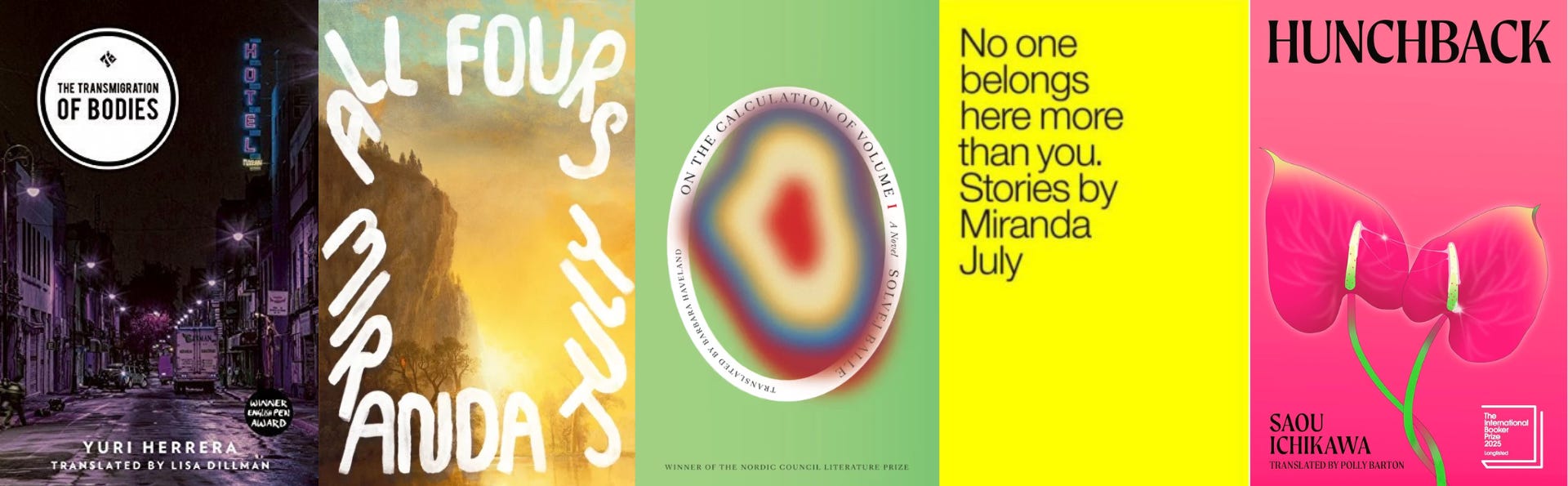
13. The Transmigration of Bodies by Yuri Herrera ★
Something about this world and protagonist just grossed me out. I get the feeling that it was intentional, but it’s just not my style. It’s a neo-noir gangster tale set in a small Mexican town during a mysterious epidemic and follows a fixer as he tries to broker a morbid trade between two warring drug families while simultaneously seducing a hot girl in his apartment building. I’m sure it’s deeper than that but I’m uninterested in dissecting it further. Sorry, next!
14. All Fours by Miranda July ★★★★★
I needed something I was confident would bring me back from the previous book, so I finally remembered to read All Fours and it blew me away. Which was unsurprising but still completely satisfying. It’s a bizarre story about art, aging, intimacy and total reinvention that is neurotic and sexy in equal measure. Following a somewhat famous artist from L.A. on a short-lived road trip turned midlife rediscovery, readers are forced to question the power we have to shape and reshape our own lives. By painting a clear and beautiful and hilarious picture of a woman blowing up her own life for the sake of an all-consuming feeling she doesn’t quite understand, July touches deftly on the fear of losing ourselves to our choices, our relationships, our obligations and our own desires. I laughed, I cried, I pledged to become a better writer.
15. On the Calculation of Volume (Book 1) by Solvej Balle ★★★
The short story: incredibly cool concept set at a pace that often lulled me to sleep. Again, this one gets lots of points for telling such an original story, even if it is a bit Groundhog Day. But protagonist Tara Selter is no Bill Murray, and Balle takes a far headier route to tell this time-loop tale of a couple drifting apart due to an absurd but endless predicament. I love thinking about time and how it shapes our experiences and understanding of our world, so this sent me down my own philosophical rabbit holes. But Balle goes to great effort to humanize this experience by focusing in on questions of free will, isolation, and memory. The prose is cool and sparse which often led to this reading more like field notes than a novel of a woman in crisis; but I will definitely continue on with this series because I need to know what happens to her.
16. No one belongs here more than you by Miranda July ★★★★
Having recently become obsessed with Miranda July, I was chuffed to find this book at a flea market and promptly inhaled it. It’s a collection of 16 strange and surreal short stories connected by a universe of quirky, vulnerable characters in their uncomfortable efforts to seek connection. Through them, July insists that awkwardness, loneliness, and yearning aren’t failures, but proof of our human need to belong. I find that few authors compel me to alternate between hearty, audible laughter and teary-eyed heartache as quickly as Miranda July.
17. Hunchback by Saou Ichikawa ★
For me, Hunchback is a prime example of a cool idea executed poorly. The book brings us into the daily life of a woman with a rare congenital muscle disorder and a host of subsequent physical limitations that force her to rely on a wheelchair and ventilator. She lives mostly in her room at a care facility, but in contrast with the chaste and confined life she leads, protagonist Shaka maintains a raunchy, provocative, and uninhibited persona online. A snapshot of this hot double life would have been a great on it’s own, especially because Hunchback was just 110 pages. But a few plot points rubbed me the wrong way, and overall, I found the tone of the narrator obnoxious.
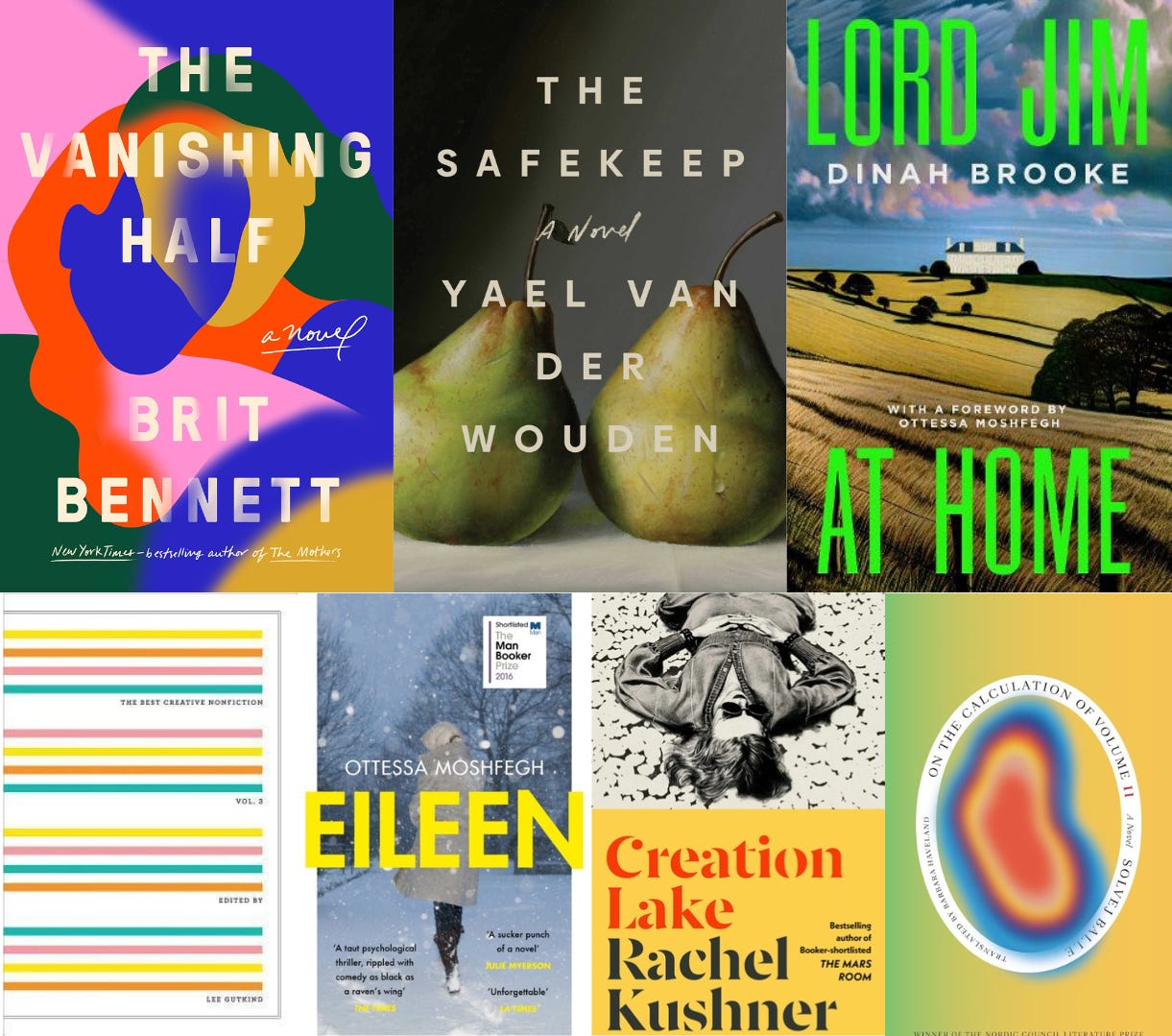
18. The Vanishing Half by Brit Bennett ★★★★★
I’m incredibly late to this party, so I won’t go too deep into this review because seemingly everyone read this five years ago. But briefly, this absolute masterpiece of historical fiction tells the story of family separated by prejudice, opportunity, and decades past. It’s about the absurdity of race and how we all have the ability to craft our own stories and build our own futures even though we can never really escape ourselves or where we come from. I love when I really have no idea how a book will turn out, and The Vanishing Half kept me in that constant state of curiosity. Each twist and jump ahead in time led me further into a genuine love for each character until finishing the book felt like saying goodbye to close friends I was sincerely rooting for.
19. The Safekeep by Yael van der Wouden ★★★★
Goddamn. The only reason The Safekeep isn’t getting 5 stars from me is because she saved all of the good stuff for the last half of the book, so it took a while to get to a point of absolute astonishment for this story and author. But I got there, no doubt. Set in the Dutch countryside in 1961, we get to know a frigid, lonely woman during a summer than changes her entire life. This book has everything — a love story, a revenge plot, and an emotional illustration of horrible betrayal in the Netherland’s history that I never knew about. And it’s all set in a world that is painted for us in stunning and lyrical descriptions of summer in the Dutch countryside. I couldn’t remember the last time I finished a book feeling so differently about the protagonist than I did when I started.
20. Lord Jim at Home by Dinah Brooke ★★★★★
But then I read Lord Jim at Home and although I started off feeling protective and heartbroken for little Giles, I finished the book hating his every thought and action. This book is so different to anything I’ve ever read, not only in content but in form. The detached third person narration is clinical and cold as it takes us along to watch Giles Trenchard live his first 20-something years. After a childhood shaped equally by neglect and entitlement, Giles turns into a pathetic young man haunted by his father’s unmet expectations. Brooke illustrates this world of British snobbery in a gruesome clarity that gave me full body flinches for a number of reasons. Yet I couldn’t put it down. If you’re looking to be disturbed, dive right in.
21. The Best Creative Non-Fiction Volume 3, edited by Lee Gutkind ★★★
As an amateur essayist, I try to read essays just as much as I read novels. So this felt a little like research. The 22 essays in this collection didn’t have a connecting theme, but the diversity in style and topic was refreshing to see as a study of what compelling storytelling is made of. My personal favorites ranged from an examination of Asian identity and masculinity in light of the Virgina Tech Shooting to a touching depiction of what actually happens during an abortion. Not all of the stories were that heavy, but most of them were insightful, smart, and taught me something about writing.
22. Eileen by Ottessa Moshfegh ★★★★
A friend recommended Lord Jim at Home because it’s been influential to Ottessa Moshfegh, whom I love, and I can absolutely see the connection. The titular character, Eileen, is as grotesque and delusional as both Giles and Moshfegh’s nameless woman in My Year of Rest and Relaxation. Only without any of the elitist trappings to hide behind or glorify the experience. Eileen works at a juvenile detention center in a small town that she’s methodically planning on escaping, but when a new friend enters her world, things take a turn. It’s a dark, psychological take on the vulnerability of isolation, the foolishness of obsession, and how ambiguous morality can be.
23. Creation Lake by Rachel Kushner ★★
Note: I sadly forgot this book in Oslo before flying home for the holidays, so this review is based on the first 250 or so pages out of just over 400.
I really wanted to like this book, but so far, it’s meh. The idea is interesting enough, but I’m over half way in and it doesn’t feel like much has happened. For something described as a “thriller” and “spy novel”, I’m drowning in historical context. We follow the protagonist, Sadie, who is an undercover independent investigator hired to infiltrate a revolutionary group in France. But so far, all she’s done is cozy up to her contacts and get on my nerves. She’s giving unlikable, arrogance. And she’s meant to be a sexy spy but her sex appeal is all tell, no show. Anyway, I’ll definitely be finishing this when I get home, especially because I heard that the last 100 pages is where all the action is. So I will come back and update this when I’m done.
24. On the Calculation of Volume (Book 2) by Solvej Balle ★★★★
I’m so glad I continued on with this series because I enjoyed this next installment much more. Poor Tara Selter decides to take her timeloop into her own hands and craft a whole year in any way that she can. Continuing on some of the same themes as Book 1, Book 2 blossoms into a reflective attempt at finding social connection amidst the isolation and taking control of the physical embodiment of time.
Although it was very difficult to narrow it down, my top 5 are below (in no order):
At the end of this year, I have a much clearer sense of the types of books I want to read, what I gravitate towards, and what tends to send me straight to sleep. I want to read funnier books, but I tend to go real dark, slow, and introspective. Why is that? If you’ve made it this far, please recommend some funny books that maintain depth and complexity!
In 2026, I still want to keep on with my effort to read all of the unread books on my own shelf, so I might still force myself to trudge through a random title I picked up at a flea market years ago. But I’m much more comfortable admitting when I need to put away the poor rescued paperback and treat myself to something new and shiny from the bookstore that I actually want to read. It’s for my own good, after all. To keep with the progressive goal-setting, I’ll aim for reading 30 books next year. Wish me luck!
I'm so happy you wrote this as I now have 8 (!) books I'm dying to read in 2026. Book tips are so sacred and important x
Happy to see you growing your time reading; so many different cultures and ideas and new authors for me to explore! Happy reading in '26❤️📚